
Challenge 1
Uneven, concentrated demand
Traffic clusters in streets, venues and transit approaches, creating hotspots the macro layer alone was not dimensioned for.

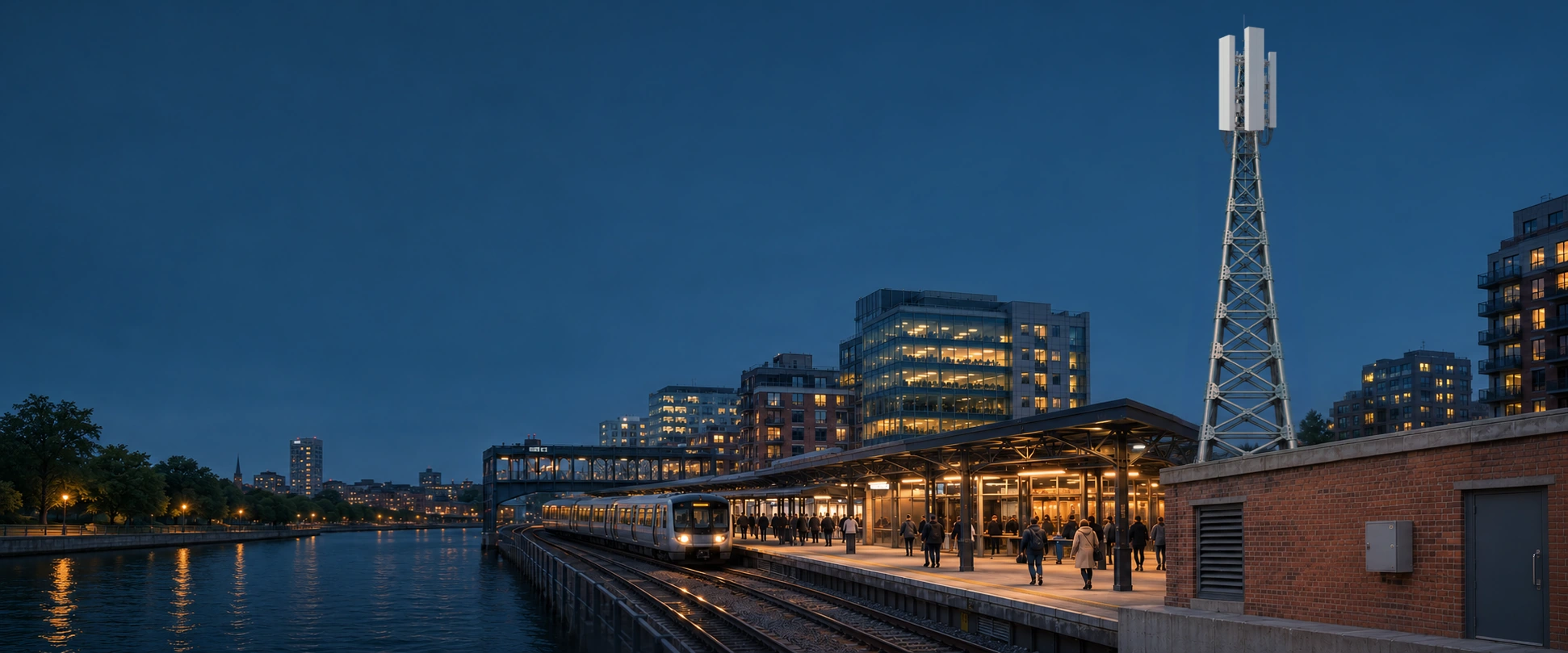
NETWORK NEED · URBAN CAPACITY
Targeted street-level capacity where urban demand is concentrated.
Network densification adds radio capacity in the specific streets, venues and transit areas where mobile demand concentrates, using street-level radios beneath the macro network rather than expanding citywide coverage.
Parallel Wireless GreenRAN™ solutions combine UNITY RAN™ as the RAN foundation with INFINITY AI™ for centralized management, automation, optimization and energy management, with 2G, 4G and 5G support where the deployment requires it.
Needs
Macro networks provide the broad coverage and capacity foundation for cities, but traffic does not arrive evenly. Streets, venues, commercial districts, transit approaches and other hotspots can need additional localized capacity beneath the macro layer.
Challenge 1
Traffic clusters in streets, venues and transit approaches, creating hotspots the macro layer alone was not dimensioned for.
Challenge 2
Street-level programs depend on site availability and on the fixed or wireless backhaul that can be reached at each location.
Challenge 3
More sites mean more power draw. Energy use at each node, and the power available on the street, shape what is viable to deploy and run.
Challenge 4
Localized interference and a growing number of small sites add operational load, without blurring hotspot capacity into wider macro coverage.
Localized capacity for busy streets and commercial districts beneath the macro layer.
Targeted capacity for venues and gathering places where demand concentrates.
Localized capacity around transit approaches and high-traffic arrival points.
SOLUTION
Parallel Wireless places street-level radios where demand is concentrated, adding capacity without expanding the macro network’s coverage area.
STAGE 01 / DESIGN
Coverage objective, demand profile, spectrum plan, sites, power, backhaul, regulation and the existing network shape the RAN configuration, rather than a generic design.
STAGE 02 / INTRODUCE
Align design, integration, testing and operational readiness with the areas and use cases that matter first.
STAGE 03 / EVOLVE
Centralized provisioning, monitoring, automation and software lifecycle management keep visibility as the footprint grows, with a clear path to expand.
SITE PLANNING
Equipment and mounting choices suited to each site
Spectrum assigned to the deployment
Transport options available at the site
Interfaces required by the agreed design
Available power and site supply
THE GREENRAN PORTFOLIO

Energy-efficient radio solutions for macro, metro, Mini-Metro and Massive MIMO deployment needs.
Explore
The RAN foundation for targeted capacity in hotspot and localized demand scenarios, supporting 2G, 4G and 5G where the deployment requires it.
Explore
INFINITY AI™ provides centralized management, automation, analytics and optimization for localized capacity across the wider network, including energy management and remote software lifecycle management.
Explore
Multi-operator network sharing supporting MOCN and MORAN models while preserving operator control.
ExploreCASE STUDY
A crowded station can need more capacity without needing more citywide coverage.
An operator can compare demand at station entrances with conditions in the surrounding district. A before-and-after review can test whether the additional capacity serves the places where people gather.
The macro network remains the broad coverage and capacity foundation. Densification is a focused complement: it places localized capacity at hotspots rather than extending coverage across the city.
Street-level sites are planned alongside the existing macro network. The operator reviews the local radio environment when choosing where and how to add capacity.
Power and backhaul availability are assessed site by site during planning. The design reflects the supply and transport options available at that location.
Yes. UNITY RAN supports 2G, 4G and 5G where the deployment requires it, so localized capacity can follow the operator’s multi-generation plan.
INFINITY AI provides centralized provisioning, monitoring, automation, software lifecycle management and optimization, so operating teams keep visibility as sites are added.
Service
Design before deployment

Product
The 2G/4G/5G RAN foundation
Product
Management, automation and energy
Add targeted capacity at the street level while preserving the macro network as the citywide foundation.
Discuss your densification plan